





Protein powders and spice blends are among the most challenging examples of powder mixing. Protein powders are light and fine, generate dust easily, and their recipes contain very small proportions of flavourings or sweeteners. In spice blends, particle sizes vary widely, and some spices form lumps because of their oil content. In this article, we explain why these two product groups are difficult to mix and what to look for when choosing a mixer.
What Makes Protein Powder Difficult?
- Low bulk density: One litre of protein powder typically weighs between 0.3 and 0.5 kilograms. Mixing a batch of the same weight requires a much larger volume than for sugar or salt.
- Minor ingredients: Ingredients such as flavourings, sweeteners, vitamins and minerals make up a small part of the recipe, but they must be present in the same proportion in every serving.
- Dust and moisture: Fine powders become airborne during loading and discharge, and can form lumps when they absorb ambient moisture.
- High-value raw material: Product left in the vessel from batch to batch is a direct cost.
What Makes Spice Blends Difficult?
- Different particle sizes: Ground cumin may appear in the same blend as chilli flakes or dried herbs. The greater the difference in particle size, the more prone the product becomes to segregation after mixing.
- Oily and sticky spices: The oil content of some spices leads to lump formation.
- Loss of aroma: Prolonged and harsh mechanical action can cause the product to heat up and its aroma to weaken.
- Frequent recipe changes: Spice producers prepare many different blends in a single day, which makes cleaning time critical.
Which Mixer Type?
For both product groups, mixers with a rotating body stand out because they blend gently without applying ribbon pressure to the product. The choice depends on the product's characteristics and the production pattern:
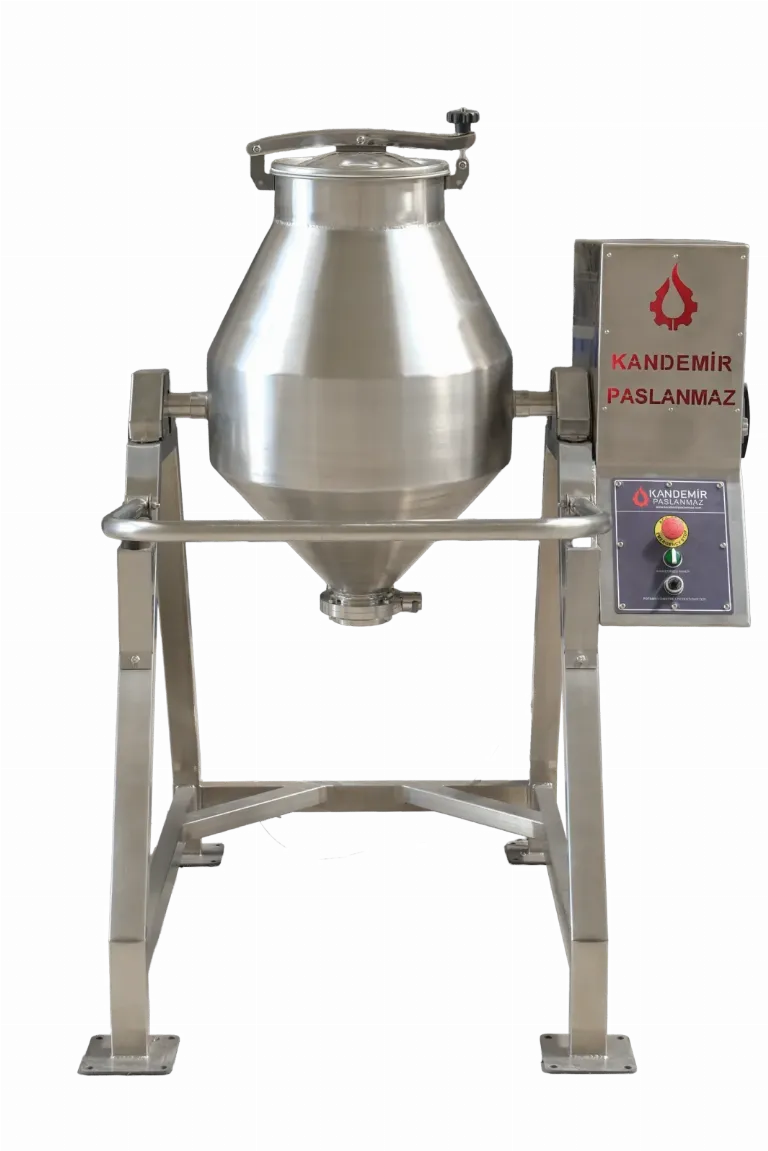
- Conical mixer: Its cone-shaped outlet allows the product to discharge with minimal residue. With high-value raw materials such as protein powder, it reduces losses between batches.
- Cubic mixer: Its multi-directional movement helps distribute powders of different densities and particle sizes evenly. It is preferred in spice and coffee blending facilities and in production with frequent recipe changes.
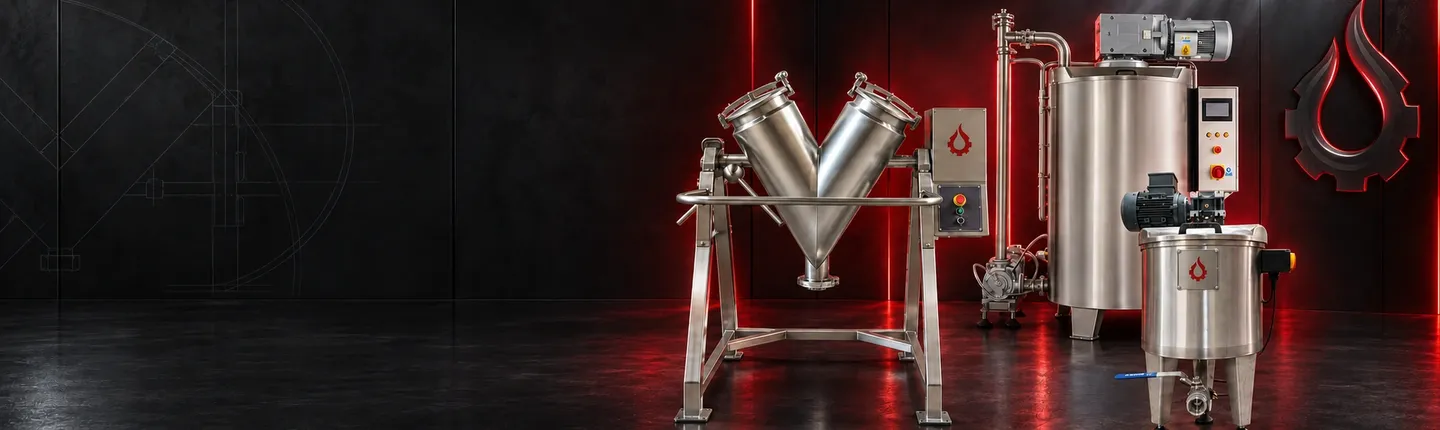
- V-type mixer: Suitable for free-flowing powders and for recipes with precise ratios, such as flavourings or sweeteners. An optional internal agitator can be added for products that tend to form lumps.
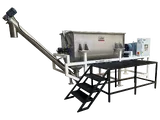
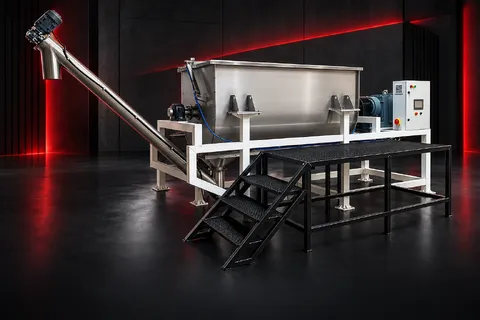
- Horizontal ribbon mixer: Suitable for operations that run very large batches or spray oil or liquid flavouring into the blend. For spices with friable particles, the ribbon speed must be set correctly.
Distributing Minor Ingredients Correctly
Adding an ingredient present in very small amounts directly to a large batch makes it difficult to distribute evenly throughout. Common practice in the industry is first to make a premix of this ingredient with a small portion of the main powder, and then add it to the main batch. Keeping the loading sequence fixed also improves consistency from batch to batch.
Watch the Density in Capacity Calculations
Because protein powder has a low bulk density, the required machine volume turns out larger than expected:
- Example: If a batch contains 250 kg of protein powder with a bulk density of 0.5 kg/L, the product volume is 500 litres.
- For a fill level of approximately 50% in a conical mixer, a 1,000-litre model is required.
In spice blends, density varies considerably from recipe to recipe, so the calculation must be based on the measured bulk density of your own product.
Dust and Hygiene
Mixers with a rotating body are closed during mixing. As a result, the spread of fine powder into the surrounding area is largely limited to loading and discharge. Smooth stainless steel product contact surfaces reduce the adhesion of oily spices and protein powder and make cleaning easier.
Test a New Recipe on a Small Batch First
For a new flavour or spice blend, you can use laboratory mixers to run small-batch trials and find which type is suitable and how much mixing time is sufficient. The results obtained can be transferred to a production machine of the same type.
You can find our other machines used in food production on the Food and Beverage page. If you share your recipe and batch size with us, we can determine the right mixer together.